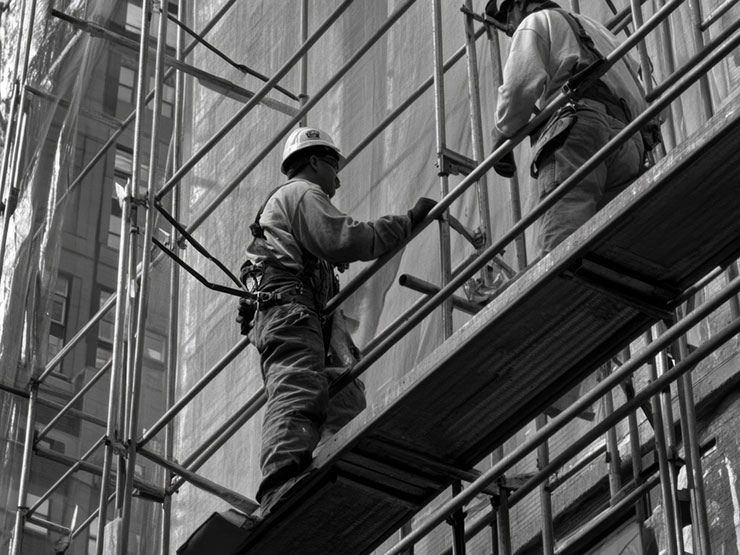
The skyline of New York City, from the towers of Midtown Manhattan to the ongoing developments across the boroughs, is a testament to the hard work and skill of construction workers. These individuals work at great heights and in demanding conditions to build our communities. Due to the inherent risks associated with this work, specific laws are in place to protect them.
One of the most significant is New York's Labor Law 240, often called the "Scaffold Law." This law is designed specifically to protect workers from injuries related to falls and falling objects, which are among the most serious dangers on any construction site.
This law establishes clear responsibilities for safety on job sites, focusing on holding property owners and general contractors accountable for providing a safe environment for workers performing tasks at different elevations.
Key Takeaways about New York’s Labor Law 240
- New York Labor Law 240 offers specific protections to workers engaged in construction, repair, or demolition tasks that involve elevation-related risks.
- This law places a high level of responsibility, often called "absolute liability," on most property owners and general contractors to provide adequate safety equipment.
- The Scaffold Law covers two main types of incidents: injuries caused by a worker falling from a height and injuries caused by an object falling and striking a worker.
- A claim under this law is separate from a workers' compensation claim and can allow for the recovery of damages not covered by workers' comp, such as pain and suffering.
What Exactly is New York's Labor Law 240?
New York's Labor Law 240 is a state statute that provides powerful protections for construction workers. It gets its nickname, the "Scaffold Law," because it requires contractors and property owners to furnish or erect safety devices—such as scaffolding, hoists, ladders, and harnesses—that give proper protection to workers.
The core purpose of this law is to prevent gravity-related accidents. It recognizes that workers often have little control over the safety equipment they are given or the conditions of the structures they must work on. Therefore, the law places the responsibility squarely on the shoulders of the parties who have the most control over the job site: the property owners and general contractors.
A unique feature of the Scaffold Law is that it imposes what is known as absolute liability. In simple terms, this means that if a property owner or general contractor violates the statute by failing to provide adequate safety protection, and a worker is injured as a direct result of that failure, the owner or contractor is held 100% responsible for the injury.
Under this law, the worker's own comparative negligence—meaning their partial fault—is generally not considered in reducing the recovery.
Who is Protected by the Scaffold Law?
The protections of Labor Law 240 are broad but do not apply to everyone on a job site. The law is intended to cover workers who are engaged in specific types of activities.
These activities generally include:
- The erection of a building or structure
- Demolition or tearing down a building
- Repairing or altering a structure
- Painting or cleaning a building
Workers performing these duties are the ones who face the elevation-related risks the law was created to address. However, it’s important to note that certain individuals may not be covered. For example, architects or engineers who are only on-site to perform inspections, or individuals performing routine maintenance that is not part of a larger construction or renovation project, are typically not protected by this specific law.
The law applies to a wide range of individuals who contribute to construction projects, from ironworkers on skyscrapers near the World Trade Center to painters working on a commercial building in Rochester.
What Kinds of Accidents Does Labor Law 240 Cover?
The Scaffold Law is very specific about the types of incidents it addresses. All covered accidents must be related to the force of gravity. This generally breaks down into two main categories of events.
Falls from a Height
This is the most common type of accident covered under New York's Labor Law 240. It involves a worker falling from an elevated work surface. The fall does not have to be from a great height to be covered; what matters is that an elevation difference caused the injury.
Examples of fall-related accidents include:
- A scaffold collapsing or lacking proper guardrails, causing a worker to fall.
- A ladder that is unsecured or defective slipping out from under a worker.
- A worker falling from a roof or through an unmarked or unguarded opening in a floor.
In all these scenarios, the focus is on whether the provided safety equipment was sufficient to prevent the fall.
Injuries from Falling Objects
The Scaffold Law also protects workers on the ground or at lower levels from being struck by falling objects. For the law to apply, the object must have fallen because it was not properly secured or because of a lack of a necessary safety device, like netting or a hoist.
Examples of falling object incidents include:
- A construction worker being struck by tools or materials dropped from a floor above.
- A piece of a structure, like a wall or ceiling, coming loose and falling on a worker below.
- An object falling from a hoist or crane that was being used to lift it.
For these cases, the injury must be a direct result of the application of gravity to the object that fell. These protections are vital on busy job sites, where activity is happening on multiple levels at once.

Who is Held Accountable Under New York's Labor Law 240?
The law is clear about who bears the ultimate responsibility for ensuring worker safety in elevation-related tasks. The primary parties held accountable are:
- General Contractors: The company in charge of the overall construction project.
- Property Owners: The individual or entity that owns the land or building where the work is being performed.
These parties are considered responsible because they have the authority to select and supervise subcontractors, implement safety protocols, and ensure that all necessary equipment is available and in good working order. Subcontractors may also be held responsible in some situations, but the law's primary focus is on those at the top of the chain of command.
There is one major exception to this rule. The owners of one- and two-family homes who do not direct or control the work being done on their property are typically exempt from liability under Labor Law 240. This exception protects ordinary homeowners from being sued if they hire a contractor for a home renovation project.
The Difference Between a Scaffold Law Claim and Workers' Compensation
If you are injured on a construction job in New York, you are likely entitled to workers' compensation benefits. It is crucial to understand that a claim under New York's Labor Law 240 is a separate and distinct legal action.
While both can provide financial support after an injury, they operate under different rules, involve different parties, and allow for different types of recovery. Seeing them side-by-side helps clarify your potential options.
| Feature | Workers' Compensation | Labor Law 240 Claim |
| Type of Claim | An insurance claim filed through your employer. It is a no-fault system. | A personal injury lawsuit filed in court against a responsible third party. |
| Proof of Fault | Not required. Benefits are paid as long as the injury was work-related. | You must prove that the property owner or general contractor violated the law by failing to provide adequate safety protection. |
| Who is Responsible? | Your employer's insurance company pays the benefits. | The property owner and/or the general contractor are held financially responsible. |
| Lost Wages | Covers a percentage (usually two-thirds) of your lost wages, up to a legal maximum. | Allows you to seek 100% of all past and future lost wages and diminished earning capacity. |
| Pain & Suffering | Not available. Workers' compensation does not provide any compensation for pain or emotional distress. | Yes. Compensation for physical pain, emotional suffering, and loss of enjoyment of life is a central part of the claim. |
| Suing Your Employer | Generally not permitted. Workers' comp is considered the "exclusive remedy" against your direct employer. | The lawsuit is not filed against your employer, but against other parties like the site owner or general contractor. |
You can often pursue both a workers' compensation claim and a Scaffold Law lawsuit at the same time. The compensation from a lawsuit is designed to cover the significant losses that workers' comp does not, providing a more complete financial recovery for you and your family.
Steps to Take After a Gravity-Related Construction Accident
After receiving immediate medical attention, there are important steps you can take when you’re able to protect your health and your rights. Taking organized action can make a significant difference as you begin your recovery.
- Document Everything You Remember. As soon as you are able, write down every detail about the incident. Note the date, time, and exact location on the job site. List any and all witnesses, including coworkers, supervisors, and paramedics. The more detail you can recall, the better.
- Preserve Any Physical Evidence. If you have photos of the scene, your injuries, or the faulty equipment, keep them in a safe place. Do not throw away the clothes or boots you were wearing. If a piece of equipment, like a safety harness, failed, it is vital evidence.
- Adhere to Your Medical Treatment Plan. Your health is the top priority. Go to all your doctor's appointments, physical therapy sessions, and specialist visits. Following your doctor’s orders is not only essential for your recovery but also creates an official record of your injuries and their impact on your life.
- Keep Meticulous Financial Records. Start a file for all accident-related expenses. This includes medical bills, co-pays, prescription receipts, and costs for transportation to medical appointments. Also, keep your pay stubs to clearly show the income you have lost since the accident.
- Be Cautious About Giving Statements. You may be contacted by insurance adjusters representing the property owner or general contractor. It is often wise to consult with a legal professional before providing a recorded statement or signing any documents.
Taking these steps can help create a clear and accurate picture of what happened and how it has affected your life, which is fundamental to any future claim.
New York's Scaffold Law FAQs
Here are answers to some common questions about claims under the Scaffold Law.
What is the deadline for filing a claim under New York's Labor Law 240?
In New York, the statute of limitations—which is the time limit for filing a lawsuit—for personal injury cases is generally three years from the date of the accident. It is important to act promptly, as evidence can disappear and memories can fade over time.
Can I file a claim if I am an undocumented worker?
Yes. A worker's immigration status does not affect their right to protection under New York's labor laws, including the Scaffold Law. All workers on a job site have the right to a safe environment.
What if my accident happened on a small residential project?
The law provides an exemption for owners of one- and two-family homes who hire contractors but do not direct or control the work themselves. In these cases, the homeowner is typically not liable, but the contractor in charge of the job may still be held responsible.
Does the Scaffold Law apply to accidents on ground level?
Generally, no. The law is specifically for accidents involving an elevation differential. A trip-and-fall on a cluttered floor at ground level would typically fall under a different section of the Labor Law (Section 200) or general negligence principles, which have different standards of proof.
Can my employer retaliate against me for filing a claim?
It is illegal for an employer to fire, demote, or otherwise retaliate against an employee for reporting a safety violation or pursuing a legal claim for a work-related injury. New York law provides protections for workers who exercise their rights.
What types of compensation can be recovered in a Scaffold Law case?
A successful lawsuit can provide compensation for a wide range of damages, including all past and future medical expenses, 100% of lost wages and diminished future earning capacity, physical pain, emotional distress, and loss of enjoyment of life.
Contact a Construction Accident Attorney
When you or a loved one is injured in a construction accident, the path forward can seem uncertain. Understanding your rights under complex statutes like New York's Labor Law 240 is a critical first step. The legal team at Greenberg Gross LLP is here to help you understand your options. Our attorneys have worked for years representing individuals in high-stakes personal injury cases and fighting for accountability.
We can review the details of your situation, answer your questions, and provide clear guidance on how to proceed. Contact Greenberg Gross LLP for a free, no-obligation consultation to discuss your case and learn how we can help you seek the compensation you need to rebuild your life.